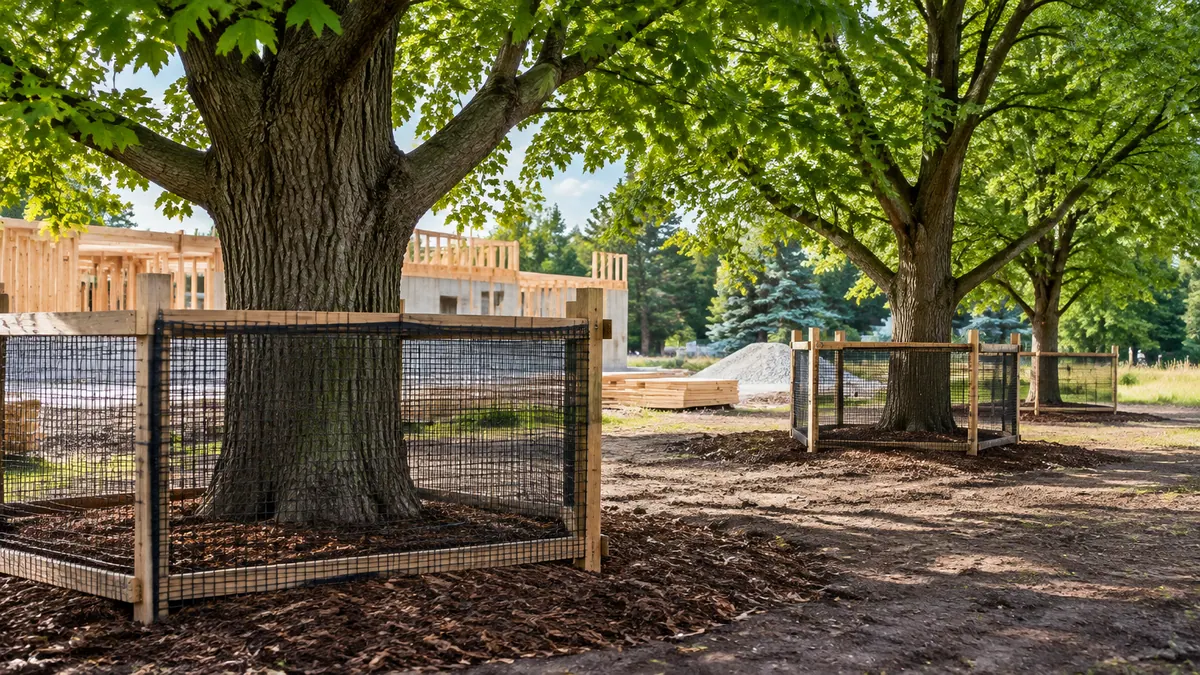
Plan before the work starts. Have an arborist assess the trees, mark the root zone, fence it off, keep machinery and materials out and decide in advance which trees stay. Most damage to trees on building sites happens early and out of sight, so early planning is the strongest protection.
Mature trees add value to a property, and many towns expect them to be looked after during a build. They are also easy to harm without noticing, because the most important part of a tree is the part you cannot see.
Below we explain why roots are so exposed on a building site, what a simple protection plan looks like and who it matters to. We also cover what to do if a tree has already been damaged. Whether you are a builder, a landscape company or a homeowner planning an addition, the same principle applies: protect first, because repair is harder.
A little time spent early, with an arborist on site, also tends to make the build smoother. Everyone knows which trees are staying, where the fence goes and who to call when a question comes up, so small problems are settled before they turn into delays or disputes between the people working on the project.
Why roots are the problem
A tree's roots spread well beyond its branches and sit close to the surface. Digging a trench, driving a machine over the soil or piling up material can crush or cut them. The tree may look fine for a season and then decline, and by then the cause is hard to trace.
That is why protection is about the ground, not just the trunk.
A simple protection plan
A good plan is short and practical. It tells everyone on site what to do and what to avoid.
- Have an arborist assess the trees before design is finalised
- Decide which trees are staying and which have to go
- Fence off the root zone before any work begins
- Keep vehicles, fuel, paint and stored material outside the fence
- Prune branches that are in the way before machines arrive, not after
Who this matters to
Builders and landscape companies carry the daily responsibility on site, while homeowners often carry the cost of a tree that declines later. A written plan from an arborist helps everyone, and an arborist report can record the starting condition of each tree so there is no argument later.
Permits can come into it too. Where a tree needs to be removed to make a project possible, we can prepare the report and handle the permit application.
What if a tree is already damaged
Sometimes the damage has already happened, and a tree that was dug around or driven over starts to look unwell. Do not wait to see if it recovers. A tree health assessment can show whether the roots have been hurt and whether the tree can be helped with care or pruning, or whether it has become unsafe.
Acting early gives a damaged tree a real chance. It also gives you a record of the problem, which helps if you need to talk to the builder, the town or a neighbour about what happened.
Working with us
Green Guard Tree Care works with homeowners, construction companies and landscape maintenance companies to protect valuable trees through construction projects. We are an ISA Certified, Fully Insured arborist based in Caledon Village, and we serve North York, Caledon, Orangeville, Brampton, Mississauga, Richmond Hill, Aurora and Newmarket.
The earlier we are involved, the more we can do. Call us when the project is still on paper, and we can help you decide what to protect and how.